SESSION 1
Festival in Lethmere
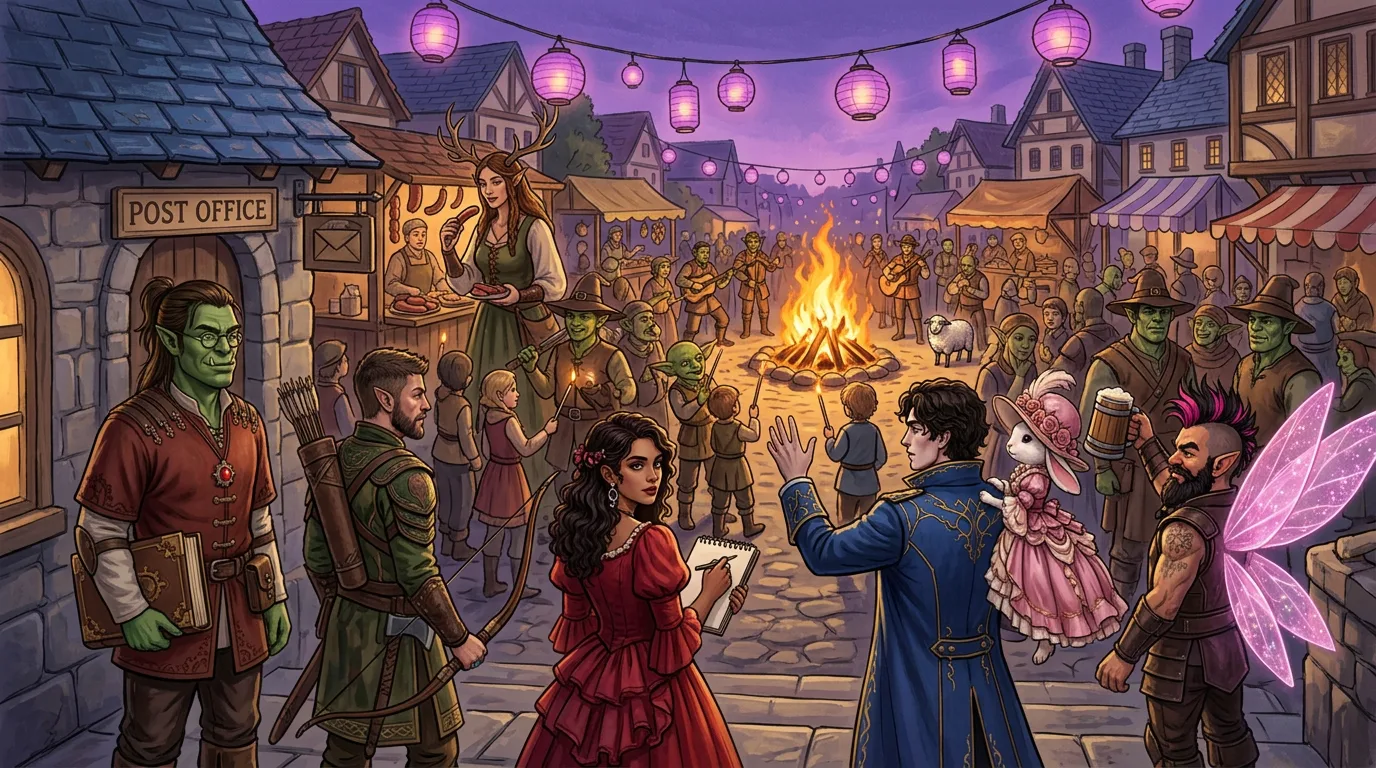
The Route Book grew a page while Horatio was not looking at it, which he considered a breach of etiquette. He had been holding it closed against his chest on the post office steps, watching the square of Lethmere fill up with lanterns and people, and when he opened it again to check the address for the fourth time there was a fresh sheet after Maggie’s note, typed in the same even letters and still smelling faintly of ink.
He read it out loud to the others, slowly, the way he would have read a court summons. Agata made a small delighted noise at the word festival. Corin, who had his back to the post office wall, said that ten years ago a zombie had wandered into this festival, and that nothing of the sort had happened since. He said it the way other people mention the weather. Celestine looked at her manicure.
“Agent Group 22,” Horatio said. “I was not aware we had a number.”
“It’s a nice number,” said Agata.
“It implies the existence of at least twenty-one others.” He closed the book and wound the leather string around it three times. “Maggie spoke of other teams. Upstairs there were six rooms.” Nobody answered that, and he had not expected them to.
The sun was going down behind the roofs. Somebody had lit the bonfire in the middle of the square, and children ran along under the strings of purple lanterns with tapers on long poles, lighting them one after another. There was music from three directions, none of it in agreement. Lethmere was a small town, but tonight it held what looked like the entire population of Karvos, goblins and humans and a family of half-orcs in matching hats and a tall woman with antlers buying a sausage, and Horatio felt a headache settle in behind his glasses.
Agata took his hand. “Come on,” she said. “There’s a tavern. Corin needs a drink. You can’t look for someone in a crowd on an empty stomach.”
He did not see how the two things were connected, but he allowed himself to be pulled.
The tavern was called the Copper Dragon. It stood at the edge of the square with its doors propped open and its tables spilling across the cobbles, and it roared like a room where everybody has been drinking since noon. Behind the bar a young man with a mess of red curls was pouring shots four at a time and calling everyone by name. People called him Ruu. He looked about eighteen, and he moved behind his counter like someone who had owned it for years, and the regulars spoke to him the way a village speaks to a boy it has raised between all of them.
At one of the corner tables sat the reason the corner was so loud.
He was the size of a halfling, and he had pink wings that glittered whenever he moved them, which was often. His hair stood up in a pink-streaked mohawk. He was conducting a story with his tankard, and the story involved, as far as Horatio could follow it, a paper crown, a goat and the entire town council of Lethmere. His accent came from some region Horatio had never visited and now felt no urge to. On his belt, beside the tankard’s empty twin, was a blue badge with a silver globe on it and a white envelope in front of the globe.
Horatio walked straight to the table. “I see that you are part of our group.”
The pixie looked up at him, then at the badge on his chest, then at the book under his arm. “Aye! Hired by, what’s her name. Mags. Maggie. Bit late, the whole interview business, but we had fun, I think.”
“I am not the biggest admirer of tardiness,” said Horatio. “But still. Welcome.” He considered the pixie’s height. “You are larger than the standard size of a pixie.”
“Had a funny tea one morning, woke up like this. Haven’t come across any mice since, so I’m counting it as a win.”
Horatio had no reason to doubt this, and said so. Then he introduced himself and the delivery crew, and the pixie said his name was Finbarr, and when Celestine was introduced he got to his feet, bowed so deeply that his wings brushed the table and told her that back in the Glade they had ridden hares, the noblest creatures of the forest, and that it was a pleasure to meet such a magnificent animal.
“Who are you calling an animal?” said Celestine.
“We are all creatures on this earth, my lady.”
“Lady will do.”
“My humblest apologies, lady.”
Celestine looked at him for a while with her ears very straight and then allowed that he might sit near her. Horatio understood that this was a significant concession.
Ruu appeared behind them with a tray of shots and asked whether any of them were joining the drinking contest. He propped a poster against the wall, painted by someone who had never been told that letters should be the same size. The main prize was four health potions.
“I’m in,” said Finbarr. “I’m already in. I was in three rounds ago.”
Corin said he would take one drink and no part in any contest. Agata said the same. Horatio said that he was not opposed to drinking, but firmly opposed to the concept of a contest, and Dorian looked at the shots the way a man looks at a river he has been told is shallow. Celestine floated up to the table and took a glass in both paws.
“Oh no,” said Dorian.
“I have never been drunk,” said Celestine. “It is time I tried it, under supervision.”
So the contestants took their stools at the big table out on the cobbles in front of the door: Finbarr, Celestine, and a moment later, at a run, waving a soup ladle and shouting “Wait for me!”, the small green goblin woman who had cursed Agata off her feet that afternoon. She had a neat black bob and wire-rimmed glasses, she was older than Horatio had first thought, and she climbed onto her chair with the air of someone returning to a throne. Then Ruu himself untied his apron and sat down beside her.
“I’ve run this thing for eight years,” he announced to the tavern, “and this year I’m finally old enough to drink. So I’m in.”
Half the square cheered and the other half began taking bets.
The rules were simple. Everybody drank at once, and whoever was still sitting at the table at the end won. Standing up counted as leaving. Ruu reminded everyone that the goblin, whose name was Rhonda, had won every year he could remember. Horatio sat at a side table with a small beer and watched Ruu, Rhonda and Finbarr drink like people who had done it before. Celestine drank like a duchess at a funeral, declared the stuff vile and asked for the next one.
It was after the second round that the contest became, in Horatio’s estimation, somewhat less than honest.
He had not planned it. He had only noticed that Rhonda reached for her glass a fraction before everyone else, hurrying the others along, which seemed to him a breach of the spirit of the rules. So when the third round was poured he lifted one finger under the table and murmured the simplest cantrip he knew, and Rhonda’s shot became, very faintly, salty. Just enough to wonder about.
Rhonda drank it, paused, and smacked her lips. “Oh, that’s nice,” she said. “Salt. My favorite.”
Horatio looked at his beer.
He was not the only one. At the next table Agata was sketching in her notebook with her body turned away from the bar, and a moment later Ruu’s glass was full of big lazy bubbles. Ruu was too busy waving at someone to notice. Then Celestine, in the middle of complaining that the drinks were bigger than she was, announced to the whole table in her most tragic voice that she really, truly wished to withdraw from competitions sometimes, and Horatio could have sworn the word withdraw carried more weight than the rest of the sentence, and was aimed at Rhonda. Rhonda looked at her and patted her paw. “Then you should, honey.” And Celestine, apparently overcome by her own performance, rose from her stool and floated away from the table with one paw on her brow.
That left three.
The fourth round went down. Rhonda twitched. Ruu flushed to the roots of his hair and declared it the easiest thing he had ever done. Finbarr went a little pale around the mouth, swallowed twice and blinked at his glass in betrayal, and a moment later Horatio heard him mutter about witchcraft. Agata leaned across to clap him on the shoulder and shouted that he should do it for Maggie.
On the fifth round Agata’s drawing turned Ruu’s shot a bright and frankly poisonous green, and Ruu saw it this time and stared at it with an expression of great suspicion. Horatio cast Message, a spell he had until now considered useful chiefly for reminding colleagues of deadlines. He sent his voice into Rhonda’s ear, made it as dry and cracked and grandmotherly as he could, and said, At my age, I really shouldn’t be doing this.
The spell let her answer, and her reply came back thoughtful and a little confused. Well. I’m not turning a hundred and twenty every day, am I. I should probably stop soon.
He did not know whether to feel proud or ashamed. He settled on the second, but only a little.
A smell crept over the table then, eggs that had given up on life, with a sharp, musky note underneath it. Horatio saw Dorian staring very hard at the lanterns and Corin examining his own fingernails with great attention. Ruu took one breath of it, rolled his eyes up to the lanterns, and shot to his feet with his hand over his mouth.
“I stood up,” he said, from behind his hand. “Oh no. I stood up.”
Then there were two.
Finbarr and Rhonda drank the next one without looking away from each other. Then the next. Rhonda’s eyes had gone soft and swimmy and she leaned across the table and told Finbarr that she had never noticed what lovely eyes he had, and then that he should take his flirting somewhere else, halfling, and Finbarr drew himself up to his full height and said he was not half of anything. Ruu, swaying behind them, set down two more glasses with great care.
Rhonda picked hers up, looked at it, said, “Ah, that’s enough,” and drank it. Then she went slowly backward off her stool like a felled tree and landed flat on the cobblestones, and began to snore. It was a tremendous snore. It went across the square and over the bonfire, and somewhere on the far side of it a dog began to bark in reply.
Finbarr sat very still for a while, not yet trusting his legs. Then he raised both arms.
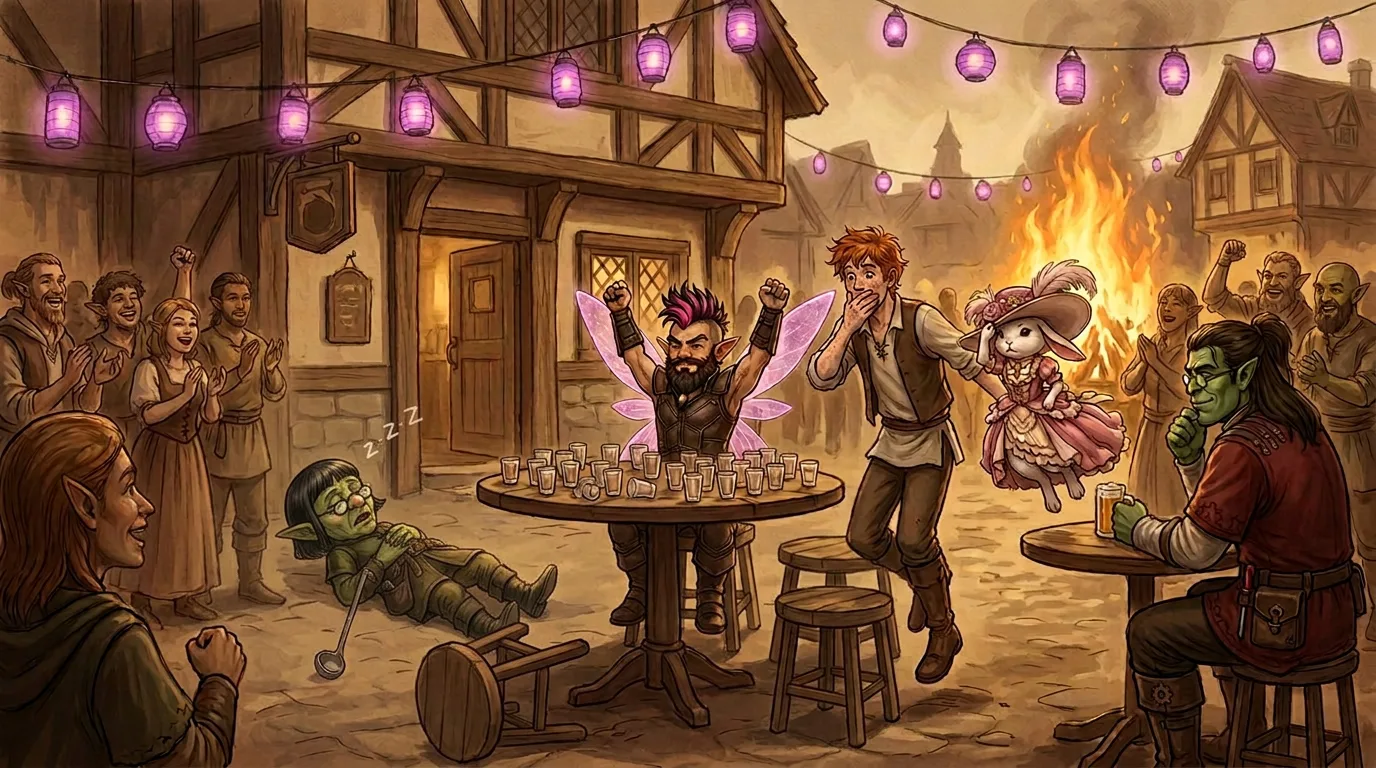
“Ten years,” Ruu said, with tears in his eyes. “Ten years and nobody’s ever drunk her under the table. All right, Rhonda. The usual. Salty cucumbers, I know.” He propped her on a bench against the tavern wall with a jug of water and put four small red bottles in front of Finbarr, who pushed them into the middle of the table and said they were for everyone.
Afterwards, over beer, Agata told Finbarr that she had never seen anything so impressive in her life, and that it had been a really cool competition to watch from the outside.
“Especially fair,” said Horatio, “since none of us interfered.”
“Absolutely,” said Agata. “Exactly.”
Finbarr looked from one of them to the other over the rim of his tankard. “There is an honor to the drinking of shots,” he said gravely, “and one should never interfere. However.” He raised the tankard to them. “If ye did. Points to ye.”
Corin did not believe in asking. Asking told people what you were looking for. So he stood at the edge of the tavern crowd and looked, and Celestine floated twenty feet up into the lantern light and looked from above, and came down to report that about three hundred people at the festival looked like wizards. Finbarr flew up after her and shouted across the square whether there was a Finethir Shinebright in the house.
“You could have just asked me,” said Ruu, collecting glasses behind them. He sounded wounded. “Finethir? Lives in the tower out past the lavender fields. Never comes out. I used to bring him food, but the order stopped about two years ago and I haven’t seen him since. Old man, white hair. Blue hat, blue robes. Pointy.” He shrugged. “He’s always been around. He’ll always be around.”
Corin bought a second beer and carried it to the corner, where Rhonda sat with a jug of water and a jar of pickles, slowly coming back to the world. He put the beer down in front of her. She looked at it, then at him, and her eyes narrowed with a suspicion so pure he felt almost at home.
“Finethir?” she said, after he had asked. “That one. Bit of an ass. Famous, apparently. I don’t care. We all have our own things to do, don’t we, dear.” She turned her head and nodded to the empty chair beside her. “He agrees with me. No. Haven’t seen him in two years.”
Corin thanked her. He did not ask who she had been talking to.
They worked their way through the festival toward the middle of the square. Corin kept his eyes on the gaps between people, which was where trouble always came from, and that was why he saw the young woman first.
She stood behind a stall heaped with sweets in colors he had no names for. There were sugar flowers that opened and closed, and a small sugar bird in a glass jar, cracked along one wing, flapping against the lid. A cluster of children watched her the way people look at the sun on the first warm day of the year. She had long blonde hair braided with ribbons and eyes the blue of cornflowers, and she looked about twenty-five. He could not have said why that number felt wrong.
He walked up to the stall. “I’m Corin,” he said. “I’m looking for a gentleman by the name of Finethir. He’s supposed to be somewhere at the festival. Have you seen him?”
“I’m Deni,” she said, and looked at him, and he felt warm.
It went right through him, from his chest out into his hands. He trusted her. That was the trouble. He had trusted nobody since Aethelgard, and he trusted her at once, the way you trust a fire in winter. He had felt this before, and recently, though he could not think where.
He murmured a word over himself and felt his attention sharpen. Behind him Agata touched his shoulder and murmured one too.
“Oh, Finethir!” Deni said. “The transmuter from the tower! We swapped recipes. He gave me the idea for this little fellow.” At the end of the counter a fox the size of a cat sat licking one paw. It was made entirely of sugar, the color of honey held up to a window, and its eyes glittered like boiled sweets. “Isn’t he cute? He was Finethir’s idea. Such a clever man. For someone so young, he knows so much.”
Corin heard it. Young. He kept his face exactly where it was.
“The thing is,” Deni went on, lowering her voice, “two years ago he just stopped coming to our meetings. Then his apprentice took over the tower. What was his name. Ahmed. Ahmed Noke. He supplies me now. But I do wonder what happened to the old man.” A child pulled at her skirt. “Yes, yes, peach or cherry, darling? Oh, and you should all join the fox race! It starts in five minutes. There’s a prize.”
“We’ll do it,” said Corin, before he could think better of it. He was fairly sure afterward that the warmth had said it for him.
“I don’t trust candy,” Horatio said behind him. “As a concept.”
Corin used the five minutes well. At the back of the crowd, where nobody was watching, he laid two fingers against his chest and spoke a ranger’s word, and felt his legs grow light. Nothing in the square would be faster than him.
There were six children in the race and five Everpost agents, though Horatio insisted that he was only present as an observer.
“Ready?” said Deni. “Go!”
The fox disappeared.
It was sitting on the counter and then it was not, with a soft sound like a soap bubble popping. Corin ran. A fox in a crowd goes away from the noise, and he went through the crowd faster than anybody had a right to, slipping between people and ducking under trays, and he was eight long strides from the stall when he heard the bubble pop again behind him, much closer to where he had started.
He stopped. He turned. He saw, over the heads of the crowd, a small honey-colored shape appear on the far side of the stall and vanish once more.
Corin swore. He did it in Elvish, because he had manners, but he did it at length.
By the time he had pushed his way back, it was over. Agata stood on top of a wagon, where she had no business being. She drew a quick line in her notebook, vanished in a puff of silver dust, and appeared on the ground ten feet away with her arms spread wide like a woman trying to catch a falling vase. The fox popped into the air right in front of her. She caught it.
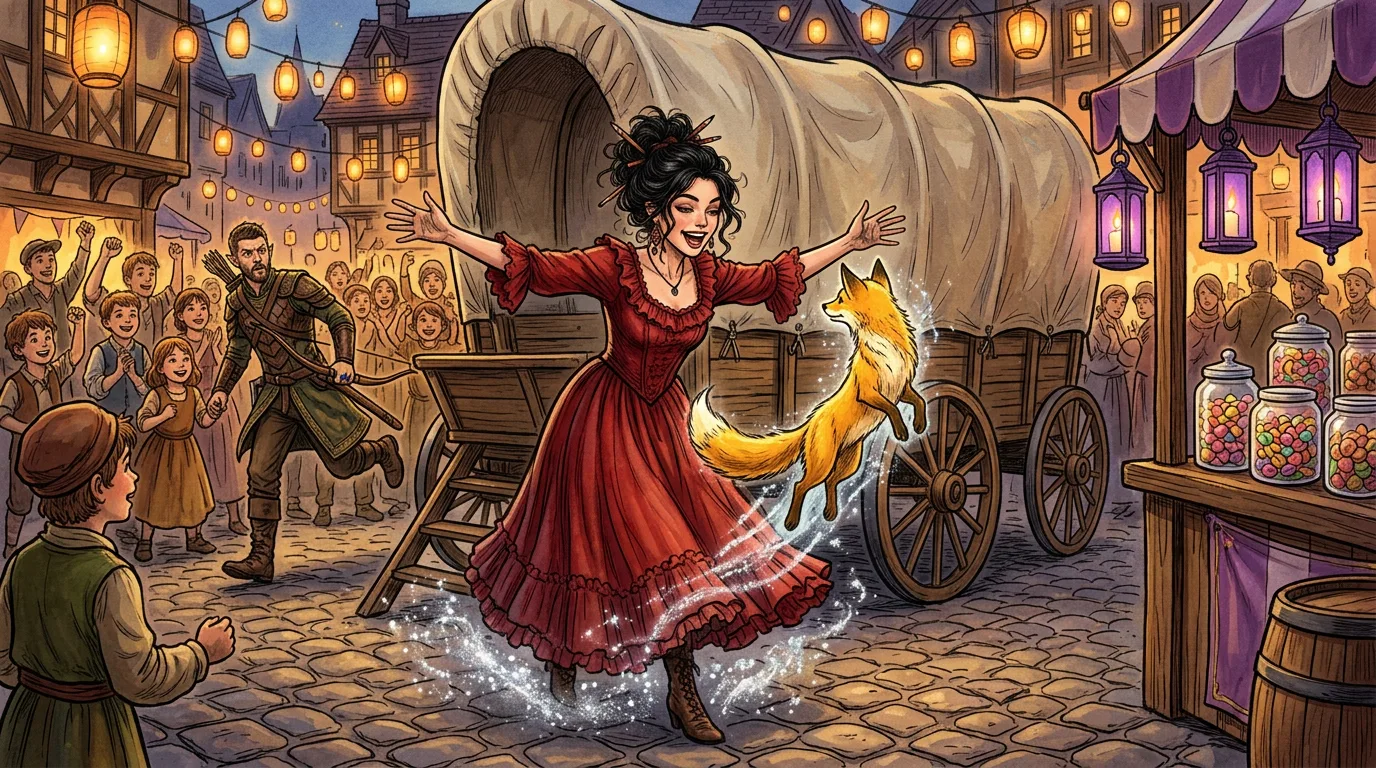
The children groaned. Deni clapped. Corin stood among the stalls with his legs still humming with the spell and understood that the lesson of the evening had been to look before you run, and that he had failed it in front of a crowd of children.
Agata held the fox against her chest and did not dare move. It was warm, which sugar should not be. It licked her thumb, very politely, and she laughed out loud.
She still could not quite believe she had climbed the wagon. She had looked at ten feet of wood and canvas and remembered Mr. Grimm’s shelf falling over with her on top of it, and then she had simply gone up. Her hands had known where to go. Horatio had shouted a word from the edge of the crowd that sounded like vindication, which she chose to take as a compliment.
Deni came over and took the fox gently from her and set it back on the counter, where it began washing its face. Then she looked at Agata for a long moment with her head tilted, the way Agata’s grandmother used to look at a drawing she had not finished yet.
“My dear,” she said. “That little silver step you did. You show potential. If you ever want a different line of work, come and see me. Sweets. Children. We’ll find something.”
“Thank you,” Agata said. “I’m very happy where I am. But that’s very kind.”
“The way you climbed up there,” Deni said. “I have just the thing.” She ducked under the counter and came back with a pair of shoes.
They were black and high-heeled and made of sugar, with heels like glass. Agata put them on because it seemed rude not to, and wobbled, and then stopped wobbling. They were as comfortable as old slippers.
“Now,” said Deni. “Try climbing again.”
Agata put one foot on the wall of the nearest house, and it stuck. So did the other one. She walked three steps up the wall and stood there sideways with her skirt hanging toward the street, and laughed so hard that Corin, below her, actually smiled.
“This candy,” said Horatio from below, “really is sticky.”
When she came down, Deni leaned close and told her, too quietly for the others, that the shoes changed size for whoever wore them, so if her handsome friend over there ever wanted to try them on, they would look beautiful on him. Agata glanced at Corin. She decided that she would mention it to him later, gently. Then Deni saw the badge on her dress, and her smile changed a little.
“Oh! You’re from the post office. When you get back, give my greetings to Maggie, will you? I haven’t seen her in such a long time.”
Agata promised she would. She did not think to ask how a candy seller in Lethmere knew the head of the Everpost, and later she was annoyed with herself about that.
They found the old man with the stew on the far side of the bonfire. He was tall and very old and stooped from a lifetime over workbenches, with a white beard singed at the edges, wire spectacles sliding down his nose and a leather apron full of pockets. He leaned on a walking stick and stood over an iron pot as big as a bathtub and gave a bowl to anybody who held out their hands. It was always free, he said. His ladle looked very much like the one Rhonda carried on her belt, and Rhonda sat at the table next to the pot, watching him over the rim of her bowl with an expression Agata recognized from her own mirror.
Agata walked up to her before she could lose her nerve. “You’re feeling better!”
“I am,” said Rhonda. “Unless somebody tries to step on me again.”
“I promise I won’t,” said Agata. “I think we started on the wrong foot. So to speak. I’m Agata.”
The goblin considered her. “Rhonda,” she said at last. “I’m terrible at small talk. Fancy a game of dice?”
Goblin dice was simple. You each rolled a die and hid it under your hand, then took turns guessing what the two added up to, each guess higher than the last, until one of you called the other a liar. Best of three.
Agata lost the first one. She went up from eleven to fifteen to eighteen, and Rhonda went to twenty without blinking and showed a fifteen under her hand, and laughed, and ladled herself more stew. Then she leaned across and said, woman to woman, that the old man was handsome at this time of year, wasn’t he, and Agata joked that if Rhonda let her win the next one she would help her flirt with him, and Rhonda laughed until she coughed. “We’ve been together for years, dear.”
Halfway through the second round a voice spoke quite clearly inside Agata’s head.
Be careful. I would not put it past this woman to cheat. Sincerely, Horatio Blacksmith.
She jumped. Horatio stood at the edge of the firelight with his bowl, carefully not looking at her. She thought very loudly at him that it was a good call, and discovered she had spent six seconds staring into the middle distance with her mouth open. Rhonda was watching her with interest.
“Sorry,” said Agata. “I was thinking.”
“About what, dear?”
“My bet,” said Agata. “Ten.”
“Fifteen,” said Rhonda.
“Check.”
Corin had touched her shoulder on his way past a few minutes before and murmured a blessing, and she still had the tingle of it in her eyes. She watched Rhonda’s hand. It was a small green hand with neat nails and very quick fingers, and it passed over the die once, quick as a wink, and when it came away the number was smaller.
“That,” said Agata, “was not the number on your die. Rhonda. You know better than that.”
Rhonda looked at her for a long moment. Then her whole face changed, and she smiled for what Agata suspected was the first time all evening.
“Honestly,” she said. “I’m starting to like you.”
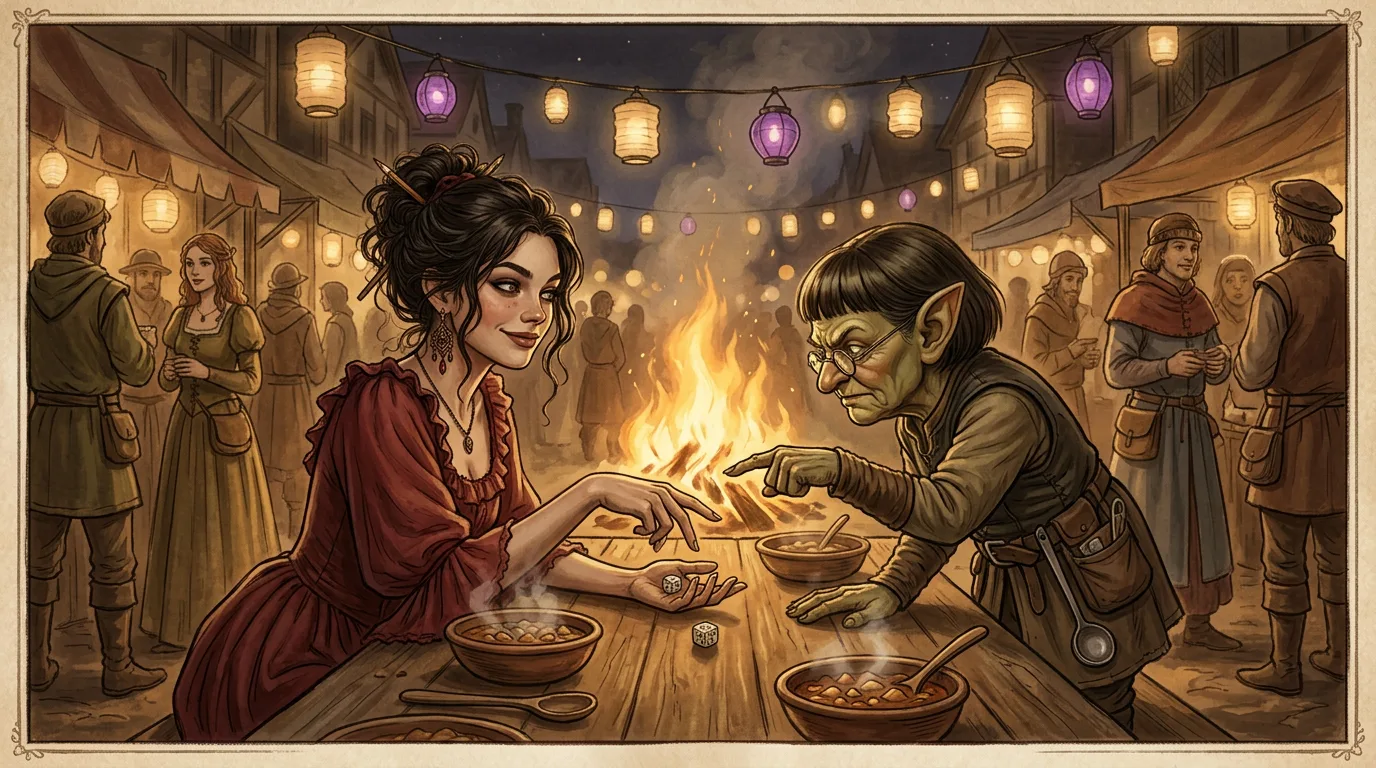
She put her hand in her apron pocket. “That was fun, but I have a date. Here. Always hated magic. But you look like someone who can use this.” She held out a wand, a crooked stick of dark wood with a knot near the tip. “Don’t ask me what it does. Point it and see.” She paused. “Not at anyone you like.”
Then she got up, walked to the old man and kissed him on the cheek. “See you later,” she said. “Remember, it’s the solstice. It’s our anniversary.” And she was gone into the crowd.
Agata held the wand very carefully by the wrong end. Then she put it away in her sleeve, beside the pencils, where it could not point at anything.
While she had been playing, Horatio had introduced himself to the old man, whose name was Alexander Nathaniel Ficklesbee the Third, though everyone called him Old Man Cinder. Nobody had delivered anything to Lethmere in a long while, he said, and he had heard the tower was empty now. “Just wait,” he said, “and the universe will send the right person to you.” He watched Rhonda go as he said it.
Then Corin surprised all of them. He crouched where a few weeds had pushed up between the cobbles, touched one, and a flower opened in his palm, purple with streaks of blue. He held it out to the old man. “For her,” he said. “For tonight.”
Old Man Cinder took it. “That’s her favorite color,” he said, very quietly.
Agata decided she was going to like Corin.
The butterscotch had been the strange part. Finbarr kept coming back to it while the others were busy with dice and soup.
He had taken it from Deni’s stall after the fox race, because it was free and sweet and Finbarr had never turned down anything that was both. It had been the best sweet he had ever eaten. Halfway through it, he had been there. Only for a breath. A laugh, nearly, from just around a corner, the way it used to come back from the wine cellar. Then the sweet was gone and the laugh with it, and Finbarr had stood among the children with his face twitching and asked Deni what she put in her candy.
“Love,” she had said. “Most of my candies have love in them these days.” She smiled, clearly considering the matter settled, and handed a child a peppermint.
He had not had a feeling like that in ten years. He had worked hard not to.
He went over to the stew pot because he had been told it was free. He took a bowl because life was short. Horatio was standing beside it sniffing his portion with grave suspicion, and Finbarr told him one should never look a gift horse in the arse, and dug his spoon in, and took a mouthful.
It tasted like home. It tasted like the Glade at the end of a summer evening, when he was much smaller than now and came in from the meadow with grass in his wings and the pot was on the fire. He knew the herbs. He knew who had cut them. He sat with the spoon halfway to his mouth and could not decide whether to put it down or eat the whole pot, and his hand shook, and the stew dripped back into the bowl.
“It’s always like that the first time,” said Rhonda from the table, with her mouth full. “Tastes like memories. That’s his thing. He does it every solstice. It’s a recipe of his late wife’s.”
“Ye do this often?” Finbarr asked the old man.
“Every year,” said Old Man Cinder, and smiled at him, and handed Corin a bowl.
Finbarr watched the elf eat. Corin chewed and frowned, waiting for a taste that did not come. Then his face went still and stayed still for a long time, and he set the bowl down on the table very gently and said nothing. Finbarr knew that look. He had worn it in a glade full of ashes.
He finished his stew. It seemed rude not to.
The kobold found them while he was scraping the bowl. Finbarr had met him earlier, a little bronze fellow playing with the children, and had caught him by the collar when he tripped over a cobblestone. Asked about Finethir, the kobold had said “Oh, the show-off” with real contempt, and added that if they found him they were not to tell him Marmaduke sent his regards.
Now he came hurrying back across the square with his hands spread wide.
“You! You’re the ones who caught the fox! You have the look of adventurers. Adventurers of adventurous potential! Are you interested in the most adventurous adventure that adventure has ever offered to adventure?”
“I love your passion for adventure,” said Agata.
“If you stop with the redundancies,” said Horatio, “then yes.”
Behind the kobold, on a track marked out with rope and straw bales, stood four snails the size of ponies, with saddles strapped to their shells. They were all chewing.
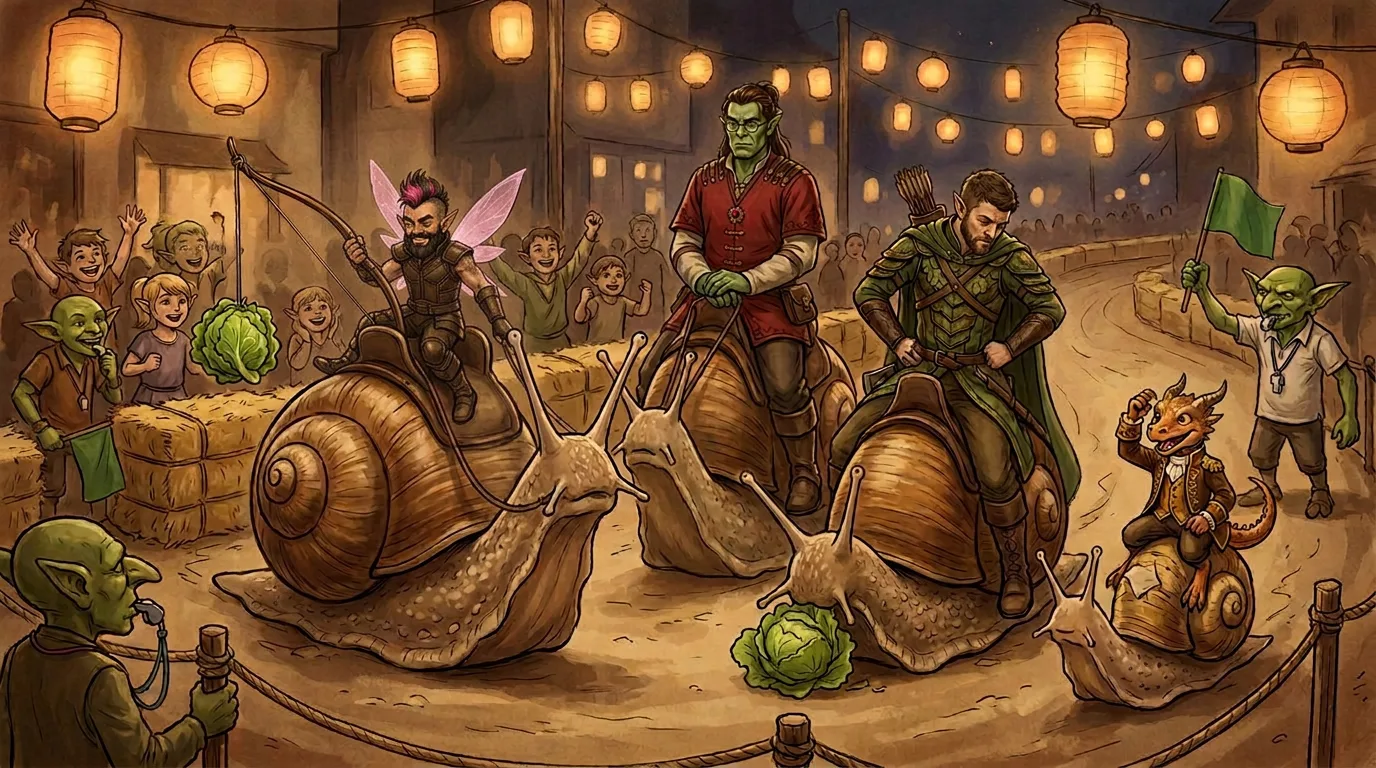
“May I introduce myself,” said the kobold, swelling. “Marmaduke the Great. Descender of dragons. Local merchant of pleasant pleasantries. Welcome to the Grand Snail Derby of Lethmere, which you have of course heard of. Everybody has heard of it. The prize is two hundred and fifty gold.” He patted the smallest snail, whose shell was slightly crumpled on one side. “This one’s mine. I’m racing against you. Three saddles left.”
“I am fucking in,” said Finbarr.
Dorian said he had had enough contests for one day, and Celestine said that a lady did not ride invertebrates. Agata kissed every rider on the cheek for luck. So it was Horatio, Corin and Finbarr who climbed into saddles that smelled of damp moss, while Marmaduke reminded them that the snails were rare and much loved and that interfering with anyone else’s snail was cheating. Four goblins in striped shirts stood along the track with whistles around their necks.
Finbarr coaxed a lettuce out of the dirt beside the track, a fat green head of it that grew in three seconds, hung it from the tip of his longbow and dangled it in front of his snail’s eyestalks.
“Let’s go, Wilbur,” he said. “There’s a whole crate of lettuce in it for ye if we win.”
Wilbur leaned toward the lettuce and began to move. It was the fastest thing Finbarr had ever seen a snail do, and still very slow. It worked until Wilbur figured out that the lettuce was not getting any closer. Beside him Corin spoke to his snail softly in Elvish, and it surged forward. Horatio sat bolt upright with his hands folded and let his snail go at its own pace, two lengths a turn, like a clerk on his way to lunch.
Then somebody in the crowd threw a head of lettuce onto the track right in front of Corin’s snail, and the snail stopped to eat it.
Corin did not shout. He leaned over the eating snail and rubbed the back of its neck, exactly the way Marmaduke had rubbed his own snail a minute earlier, and Finbarr saw his lips move and the faint shimmer of a spell go into the creature. It would have fooled any ordinary audience. Three whistles went off at once.
“Out!” said the nearest goblin. “Magic on the snail! Out!”
Corin got off and walked away from the track with his back straight and his face like a closed door. Meanwhile Marmaduke whispered into his own snail’s ear, and the snail turned its eyestalks to look at him with what Finbarr would have sworn was disgust, and refused to move. A lettuce landed in front of it on the next turn. Horatio, who had been holding back, stood up in his stirrups and shouted, “Forth, creature!” in a voice that rattled the lanterns, and his snail shot forward four lengths and drew level with Wilbur. Horatio looked across at Finbarr. “This is not over,” he said.
The crowd went wild, mostly children who had never seen anything so thrilling move so slowly, and the cheering lifted Horatio’s snail another length. Then Wilbur, with no encouragement at all, slid over the finish line half a shell ahead.
“Finally!” Marmaduke cried, throwing his arms around Finbarr’s neck. “Somebody finally did it with me! Years I’ve been promoting this! Snail racing is the future! You heard it here first. Licenses available from me.” He pressed a heavy purse into Finbarr’s hands. Then he lowered his voice. “You are, as I said, adventurers of adventurous potential. Would you be so inclined as to help me prepare a little surprise for the village? Behind the tavern. Ten minutes. Bring your friends.”
Finbarr watched him trot off. People smiled when the kobold went past, and the old men at the tables raised their mugs to him. Most folk said kobolds were small and stupid and good for nothing. Nobody here talked like that. They looked at Marmaduke the way people look at someone who has done them a kindness and never mentioned it. Finbarr had been looked down on all his life too, and decided he liked the little fellow.
He flew back to the others with the purse. “The wee bugger wants help behind the tavern in ten minutes,” he said. “We’re all right with that, aye?”
“Sure,” said Horatio. “Wasn’t there a sheep somewhere?”
There had been. Old Man Cinder had pointed it out as he left, a small woolly sheep wandering through the festival on its own, staring at everybody it passed. Then the snails had happened, and now there was no sheep anywhere.
Dorian saw the light before he saw where it came from. Something behind the tavern was glowing red, then gold, then a green that had no business being in a backyard. Celestine floated ahead of him and peered around the corner.
Darling, she said inside his head, you will want to see this.
Behind the tavern stood Marmaduke. He was breathing fire.
He was doing it the way a singer warms up, short bursts and long ones, and every burst came out a different color, blue and pink and a curl of violet that sparkled as it faded. Behind him stood five iron frames with rockets propped in them, covered in brass dials and levers and one small crank that did not appear to be connected to anything.
“My friends!” he cried. “You came! Wonderful. You see, being a kobold is one thing. Being somebody else is something else entirely.” He waved toward the square. “These people have given me and my friends a home for ten years. Tonight we give them a show they’ll never forget. Magical rockets. They make actual pictures in the sky. Takes a lot of effort to operate, and there will be flashes and bangs, so please don’t get distracted. You’ll need to work together. Budget cuts, you understand.” He burped, and the air smelled of rotten eggs again, and for a wild moment Dorian looked at Celestine. “Sorry. Hasn’t happened in a while. I’ll fly up and do the baseline. You do the highlights. Try not to set the houses on fire. I’ve done that three times, and people really don’t like it.”
“Any advice?” asked Corin.
“Don’t set your own tail on fire,” said Marmaduke. “It’s never fun.”
Then he spread his arms and fog rolled out from under his feet, thick and white, and in the fog he grew. His neck stretched and his tail swept across the yard and knocked over a barrel. Wings unfolded from his back, each one larger than the tavern roof. When the fog cleared there was a bronze dragon standing behind the tavern, and it threw back its head and breathed a long stream of flame into the sky, and the flame burst into sparks at the top like a dandelion.
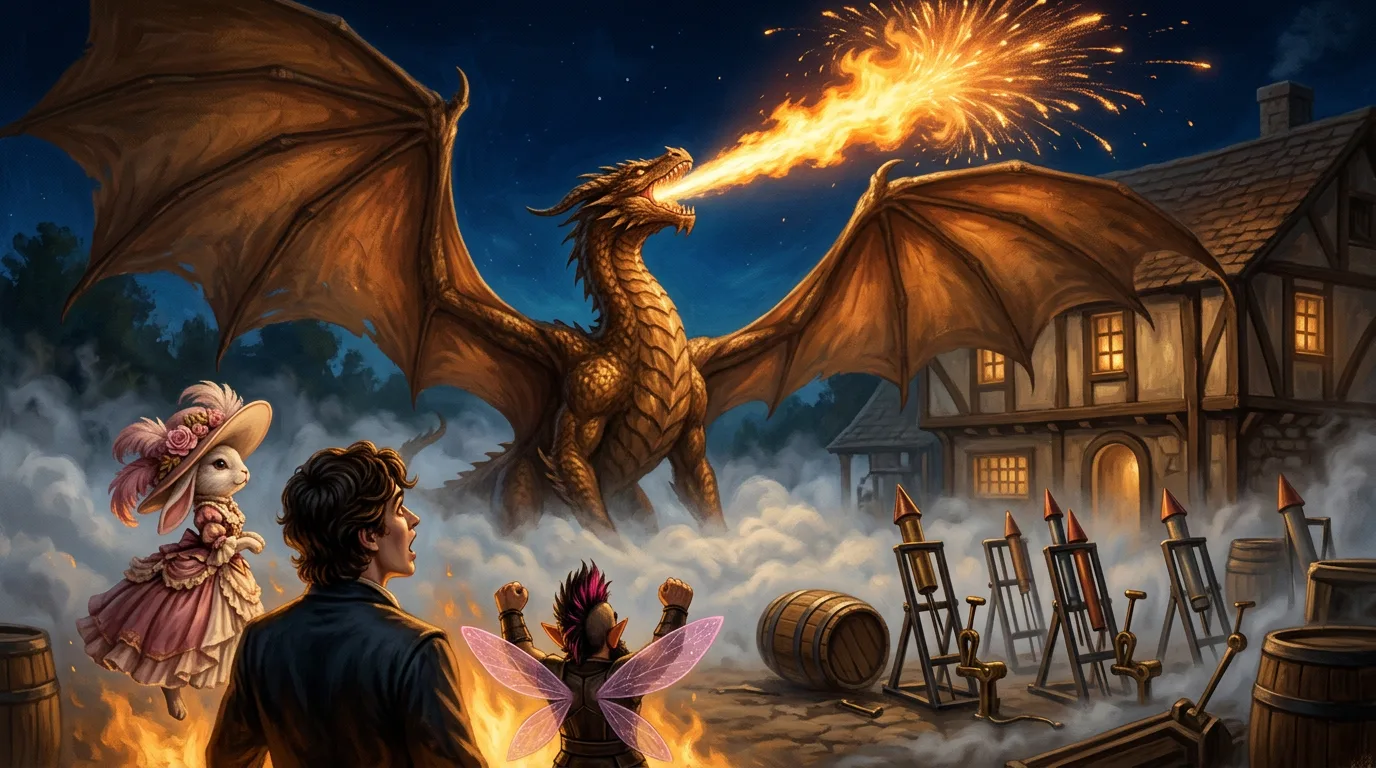
Dorian stood with his mouth open. Somewhere Finbarr was swearing in pure admiration. Dorian had read about dragons, and none of the books had mentioned that they might sell you snail tickets first.
Celestine put one paw against his cheek. Darling. The rockets.
The dragon leaped into the air and the show began.
Dorian would never be able to tell the next few minutes in any order. Light crashed down over the rooftops and the crowd screamed with joy. Marmaduke turned backflips above the tavern and came out of each one slightly lopsided. Nobody had explained the rockets, and every one of them seemed to need two people on its levers and a third on the crank, so the five of them ran from frame to frame shouting over the bangs. Horatio pulled a lever and made a strangled noise. Agata yelled at Corin to turn the dial the other way, and Corin yelled back that he was, and neither of them could hear a word. Dorian hauled on the nearest crank without much idea what it did, and somewhere up there a sorcerer lit up green against the dark and flung a spell at a little house of light. The crowd cheered. One of the frames beside him was smoking. Then another was on fire. Finbarr was beating at it with his hat.
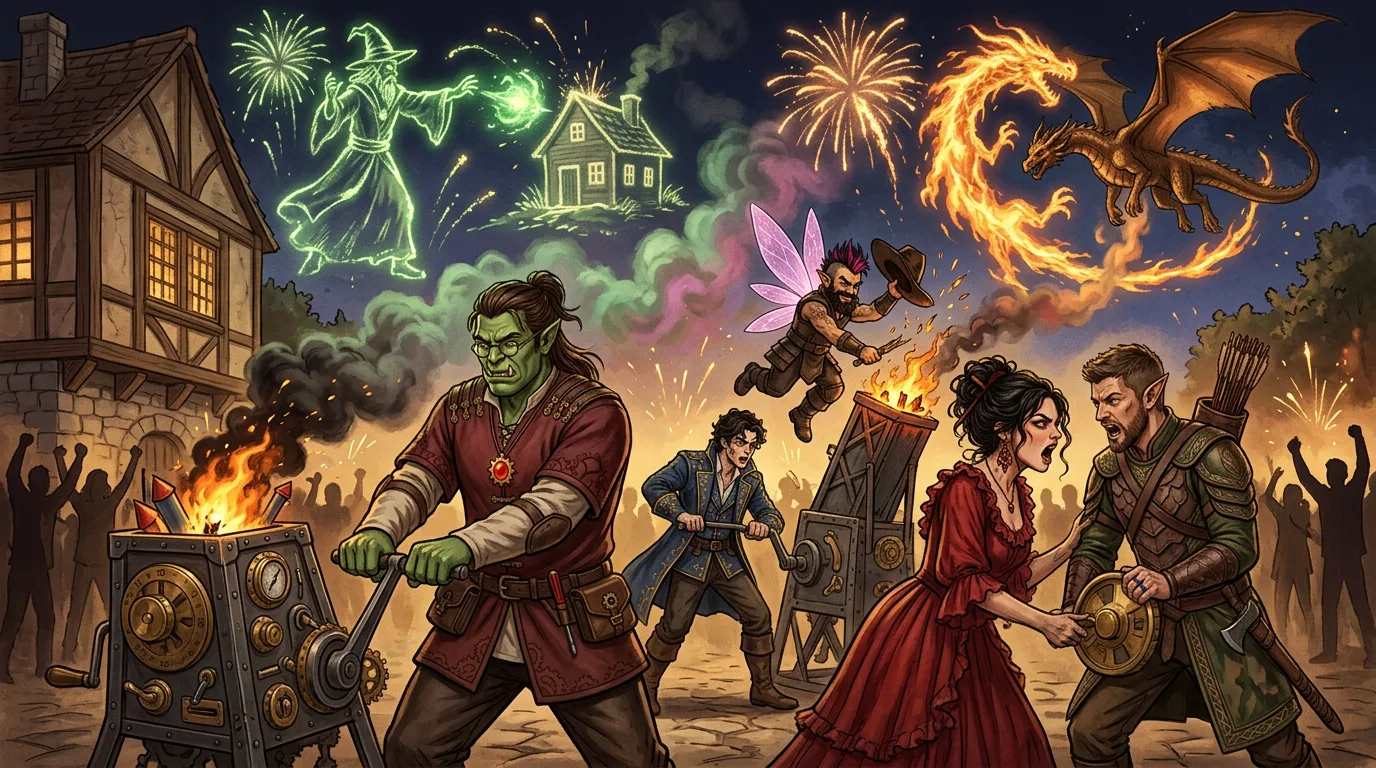
One rocket drew a man smoking a pipe, which the crowd watched in respectful confusion. One drew a dog running into a hole. The last was a dragon made of flames that wrapped itself around the real one, and Marmaduke roared with pleasure and flew straight through it. The fifth rocket never went up at all. It was still sitting in its frame afterward, waiting for someone to work it out.
Then the sky went dark, and Marmaduke came down in a tired spiral and shrank back into a kobold in a cloud of smoke. He looked at the smoking frames and at the tavern, which was still standing.
“Well,” he said, beaming. “You’re not on fire. The tavern’s still there. I think they had a lovely time.” He went to beat out the last of the flames with his jacket, with the practiced ease of someone who had spent a great deal of his life beating out fires.
Horatio stepped over to stand beside Dorian. He took off his glasses and polished them and put them back on.
“I am not,” he said, very quietly, “going to address the dragon in the room.”
“No,” said Dorian. “I think that’s wise.”
The sheep came out of the smoke at a run.
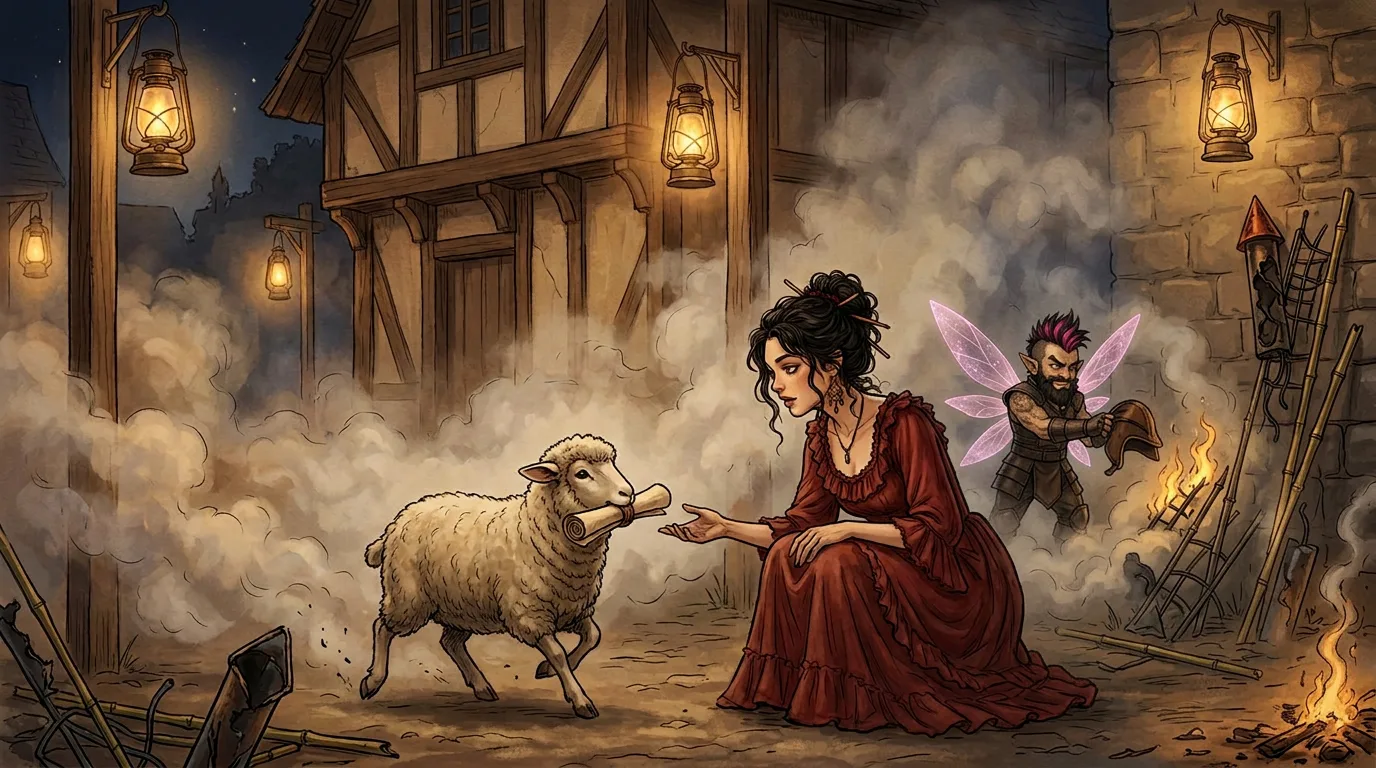
It was a small, round, very dirty sheep having the worst night of its life. It ran between the barrels with its ears flat, past Corin and past Horatio, and stopped in front of Agata, panting, and looked up at her. There was a scroll in its mouth.
Agata knelt and patted its head. “Oh, I’m so sorry about all of this. Are you all right?”
The sheep made a noise that was very close to a grunt and pushed the scroll at her.
She took it and unrolled it, and Dorian saw her lips move as she read. Then she said a word that was not in any language he knew, and the scroll crumbled into dust and ash in her hands, and she looked at the sheep with a very different expression.
The sheep said, “Baaa.”
To Dorian it was only a sheep. To Agata, apparently, it was a great deal more, because she flinched and said, “Excuse me? For the elderly? How old are you?”
“Baa-aaa,” said the sheep.
“Oh, I’m so sorry. That was rude. I was only curious.”
Dorian watched one of his new colleagues have an argument with a sheep. Agata listened, nodded, said “By who?”, listened, and said “Oh.” Then she turned to the rest of them with her eyes very wide.
“He says he’s been running around the festival all night looking for anybody magical enough to read that scroll. He says he’s been robbed. By his apprentice. Ahmed.” She looked back at the sheep. “He says Ahmed is ungrateful, untalented and should never be allowed anywhere near magic.”
“Ahmed Noke,” said Corin slowly. “The new man in the tower.”
Agata knelt again. “Excuse me,” she said to the sheep. “By any chance, are you Finethir?”
The sheep drew itself up. It was not very tall even drawn up, but it managed a certain dignity.
“Baa,” it said, and Agata translated, faintly, that he was, that he was very glad anybody was talking to him at all, and that he had been hoping for some time that someone would come along and help him.
Horatio took the Route Book out from under his arm and opened it to the page with the address, and looked at it for a long moment, and then at the sheep, and then at the line at the bottom of the page where the addressee was supposed to sign. Dorian leaned over to see. Bleating is not a signature, it said.
“Well,” said Horatio. “That explains the paragraph.”
That was when the crowd behind them parted.
Somebody large came through it, unhurried, and the people of Lethmere got out of his way without being asked. He stopped at the edge of the firelight and looked at the five of them, and at the bunny, and at the sheep standing by Agata’s feet. The sheep pressed itself against her legs and began to shake.
“Oh,” said the newcomer, and he sounded pleased. “You found sheep.”
He stepped forward.
“Guz needs sheep.”